Hey 18 Stripes readers it’s been a while! Hope everyone is doing well. Things are good up here in Canada, I am currently enjoying the 10 days of summer we get annually in the Great White North, so really can’t complain.
As we all know, there is a lot of excitement heading into the 2026 ND football season. Notre Dame has a talented roster, an excellent coaching staff and a schedule that sets up well. Training camp has finally started, but these days we only get carefully curated highlights and reports that “Player X just looks different.” Since camp isn’t giving us much in the way of actual football analysis, let’s head into the film room and take a look at some X’s and O’s.
Today we’re looking at Y-cross, a passing concept used at every level of football. Specifically, we’ll break down an incomplete deep pass from CJ Carr to Micah Gilbert in the Blue and Gold Game, along with a bonus section with a few route-running nuances that could help Mylan Graham take the next step.
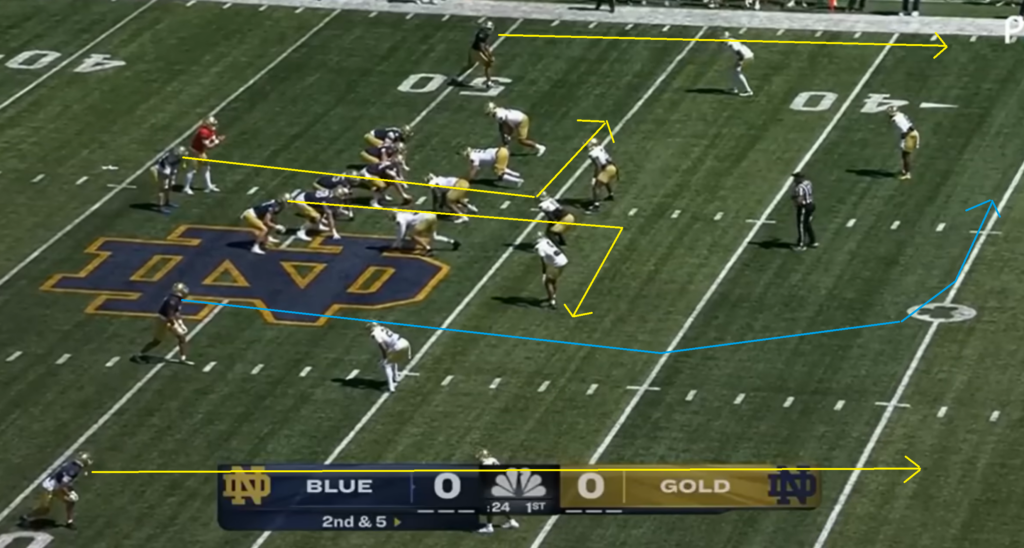
Y-cross is a foundational passing concept often installed in the spring and refined throughout the season. It can be run by tight ends, slots, or perimeter receivers, and works well from multiple formations.
In this example Notre Dame starts with a running back, tight end, slot receiver and a wide receiver to the wide side of the field, with only a single wide receiver to the short side. At the snap, the outside receivers run vertical routes (yellow arrows) the running back and tight end break out (yellow arrows) and the slot runs the Y- cross (blue arrow). As an FYI, in the broadcast Book suggested this play might be all verticals. This makes sense given the releases of the outside receivers but as the diagram shows, not all the routes are vertical.
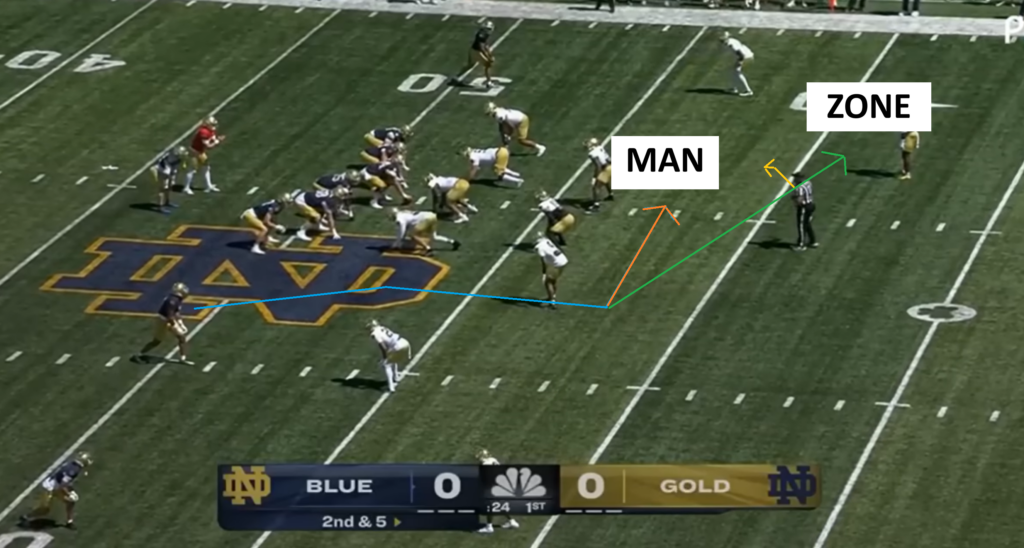
The first portion of the Y-cross is fairly consistent. The receiver works inside and then pushes vertical (blue line). After that the route is like a honey badger, you can’t kill it. Every time the defense thinks it has it defeated, the route morphs and gets open.
After the initial phase is where the honey badger style magic happens. Against zone coverage, the receiver continues across the field while gaining depth, typically aiming for a landmark around 20 yards deep (green arrow). That’s the standard version most players learn first.
As quarterbacks and receivers become more experienced, the route can evolve. Rather than simply continuing across the field, the receiver may settle into an open window in the zone (gold arrow). This adjustment requires both the QB and the receiver to see the coverage the same way and react accordingly.
If the route is so good against zone, you just run man coverage to stop it, right? Not so fast. When you play man against the honey badger it adapts and causes more problems. Against man coverage instead of following the green arrow, receivers will make a sharper cut and keep the route to a depth of 14-15 yards (orange arrow), essentially turning it into a “dig” or an “in” pattern. If run well, the sharper cut is very effective against man coverage as it makes it difficult for defenders to undercut the throw.
This is what makes Y-cross the honey badger of pass routes. Every time a defense thinks it has it figured out, the route finds another way to attack.
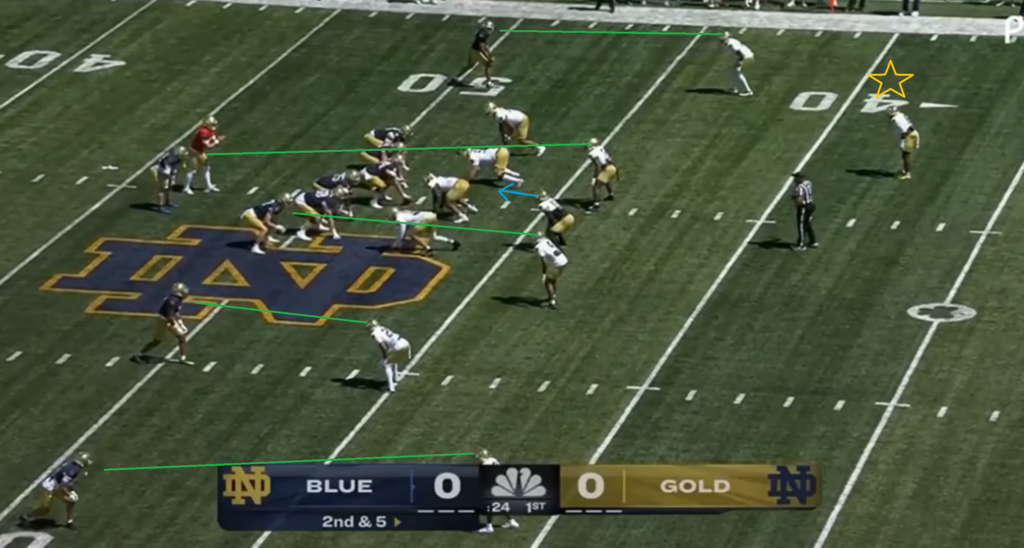
It’s spring so the defenses are pretty simple. This is man coverage (green lines), with one linebacker blitzing (blue line) and a safety who is free over the middle (gold star) commonly called cover 1.
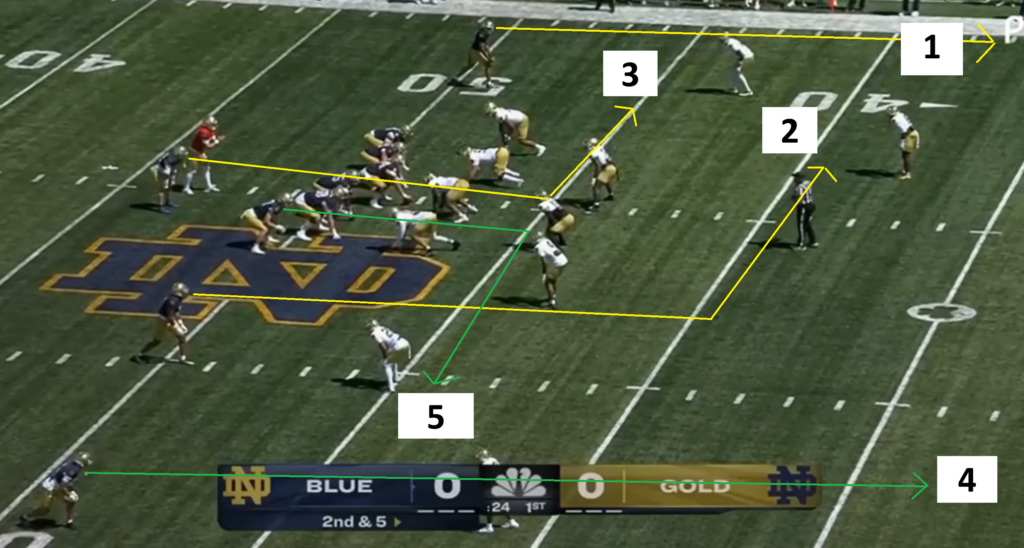
When quarterbacks first learn this concept, they’re typically taught a simple progression: read deep to short on the primary side, then work back across the field if nothing develops. It’s a progression Carr knows well.
The yellow lines show the primary read side of the play (note the yellow lines aren’t exact replicas of this passing concept, I wanted to show you how this concept stresses the defense on multiple levels and drew the lines to illustrate that in the space available).
As you can see, you get a pattern that threatens the defense deep (yellow arrow labeled read #1), threatens at mid-range (yellow arrow, labeled read #2 – this is the Y-cross) and a route that threatens short range (yellow arrow, labeled read #3). Pretty simple right?
If nothing is open on the primary side and if the QB has time they can transition to the non-primary side (green arrows in this case) and again read deepest (labeled #4) to shortest (labeled #5).
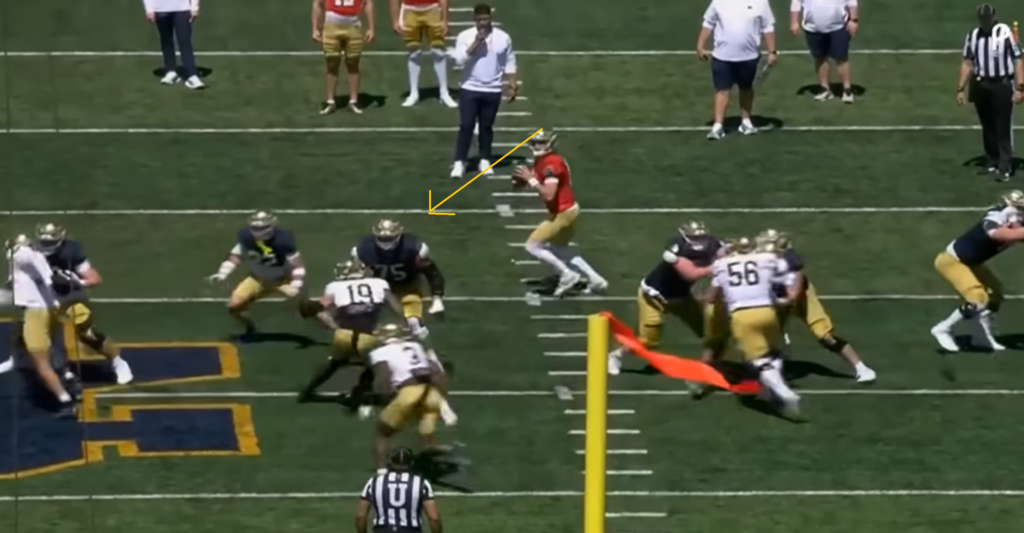
So why does CJ Carr immediately look away from the primary read side (gold arrow)? Is he confused? Or maybe Larz is just a simple, unfrozen caveman who doesn’t understand modern ways of football and has it all wrong.
Actually, this is exactly what an experienced QB does. He knows where the primary side of the route concept is, but he also knows there is a free safety to that side so he uses his eyes to drag the free safety away from the play.
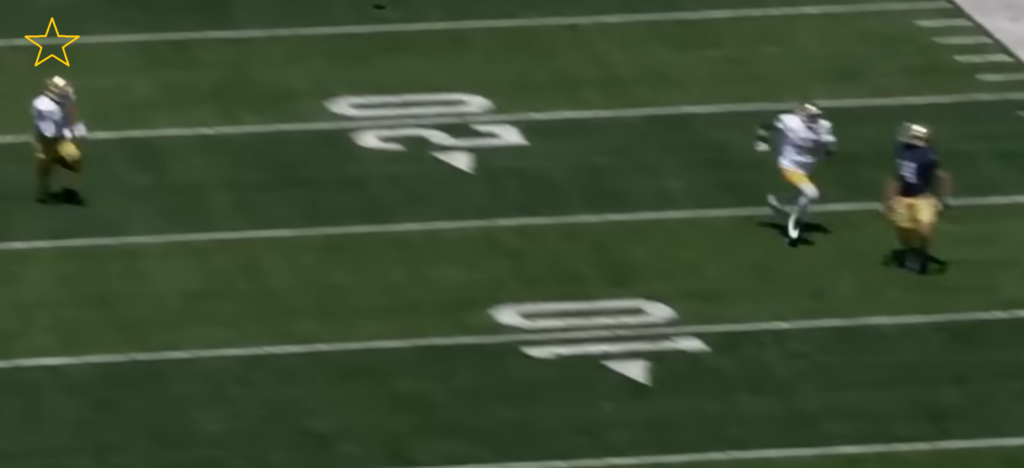
Carr reads that it is cover 1 man and decides he likes the deep pass to Gilbert outside. Personally, I wouldn’t teach a young QB to throw the deep ball against off man coverage and a free safety shaded to that side. I would teach him to move through his progression versus this pre-snap alignment and look to his second and third read. But CJ Carr is experienced and trusts both his arm and his ability to manipulate the safety, so this really isn’t a problem for him.
The safety (gold star) is nowhere near the intended receiver. Carr was able to move him out of the equation and create a one-on-one opportunity for his receiver. It’s a great example of how quarterbacks can create opportunities with their eyes before they ever release the football. Now of course, we actually have to make the catch, but that’s a story for another time.
Bonus Analysis
There are still plenty of questions surrounding Notre Dame’s receiver room heading into 2026, which makes Ohio State transfer Mylan Graham one of the more intriguing players on the roster.
This play illustrates an area where Graham can continue to develop. Everything he does here is technically correct. The opportunity lies in some of the finer details that separate good route runners from great ones.
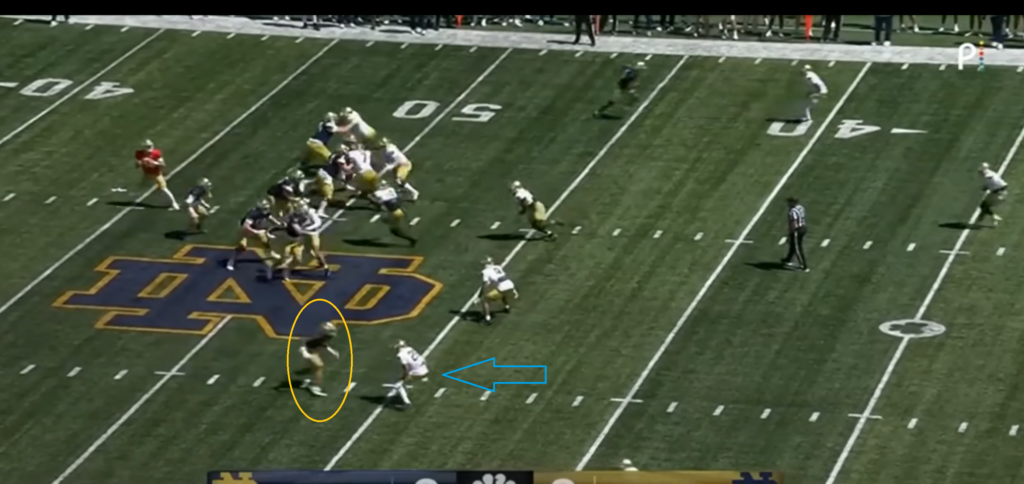
The screenshot is a fraction of a second after the snap. Graham is in the first part of the route, where he needs to get inside position on the defender. What he doesn’t realize is the defender is already shaded to the outside (blue arrow) so Graham doesn’t have to do much to get inside. An experienced receiver will recognize this and immediately focus on threatening vertically rather than focusing on getting inside. Instead, Graham slows down and gives a small fake to the outside (gold circle) to help him get inside position (which he pretty much already has, and can easily get, without the fake based on the DB’s alignment).
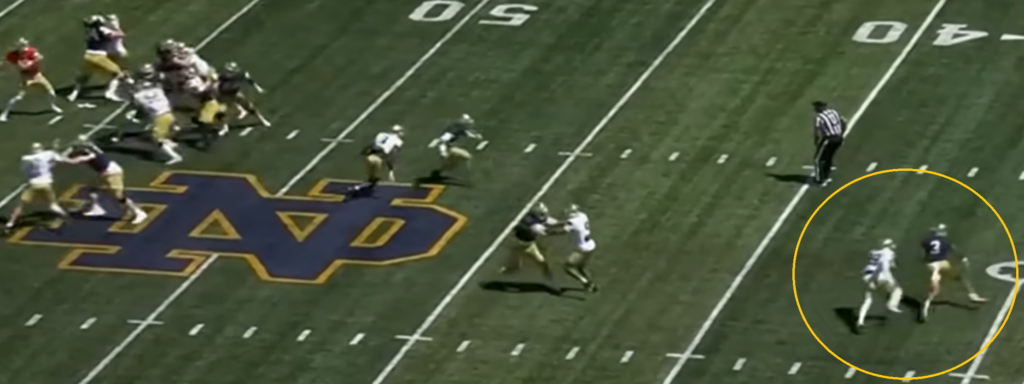
The end result is the DB is in pretty good position to undercut Graham’s route (gold circle) and he’s covered. Ideally, Graham would have abandoned the early outside fake and spent more time using what coaches call a “stair stepping” technique. This is where after gaining the leverage you want, you push vertically to force the defender to respect the deep route before making the cut. This extra vertical threat often leaves the DB a step behind when you do make the cut.
As an aside, if you watch the video of this play, you’ll also notice a slight head bob from Graham before he accelerates at the snap of the ball. This and the extra fake that wasn’t necessary are great examples of how Graham has a little extra movement in his game that isn’t helping him get open.
None of this should be viewed as alarming. Every player has small things they need to work on. Eliminating these inefficiencies is exactly the type of thing position coaches obsess over during fall camp. Graham is a talented player with obvious physical gifts and these are the kinds of refinements that can help a great athlete become a more complete receiver.
Final Thoughts
Y-cross is one of those concepts that’s simple enough to install in the spring and versatile enough to survive an entire season. Once you know what you’re looking for, you’ll probably start seeing it pop up all over the Notre Dame offense this fall. Hopefully the next time we break it down, the ball ends up in the receiver’s hands!
Go Irish!