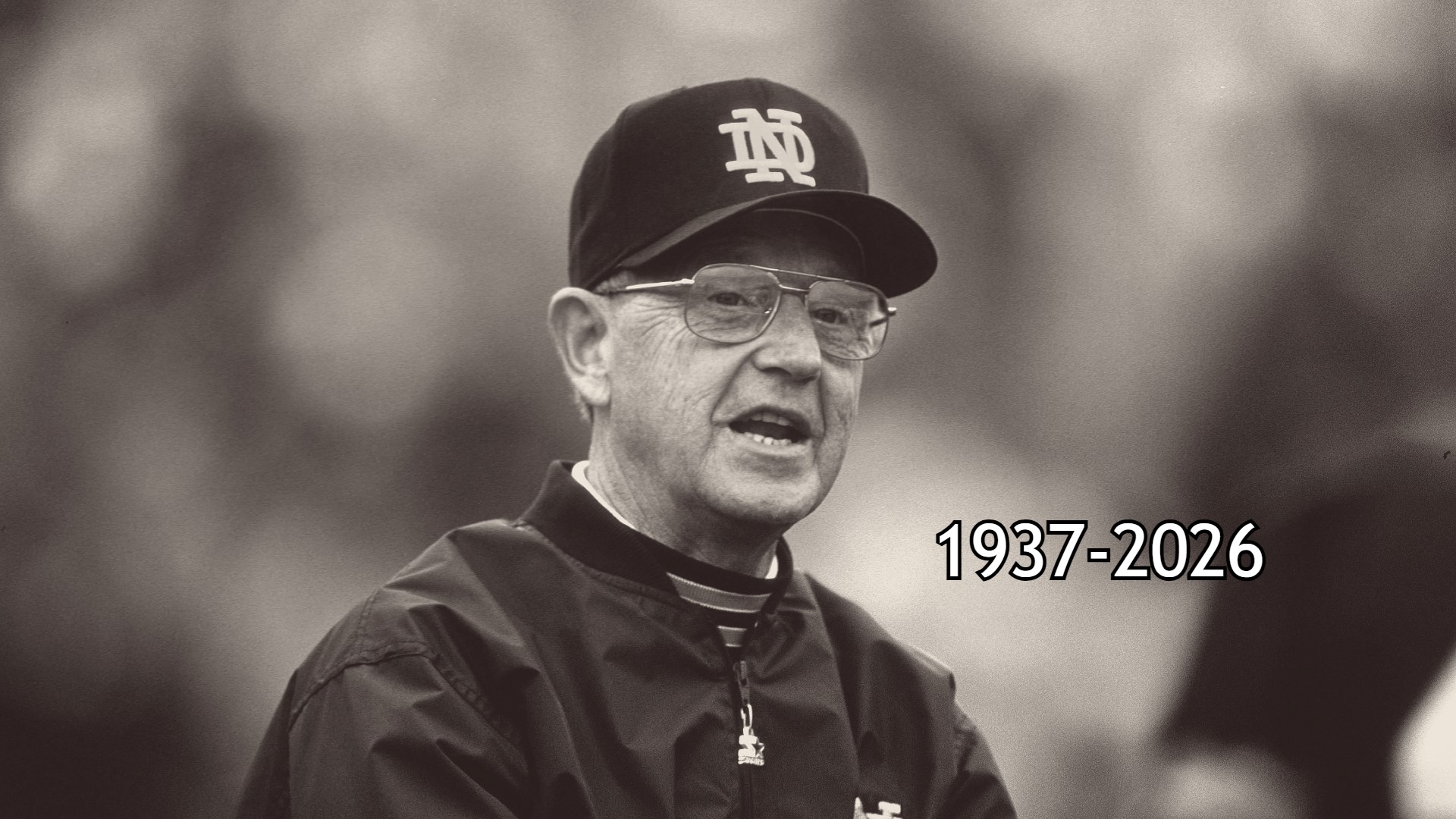
Former Notre Dame head football coach Lou Holtz passed away on March 4th just under 2 months after his 89th birthday.
To say Holtz was a monumental figure in Notre Dame history would be an understatement. To date, the last Irish coach to win a National Championship and as such the last to have a statue of himself parked outside the stadium. There can be no bigger bragging rights in college football.
Growing up, Lou Holtz was Notre Dame football for me. He was part of the unique tradition of Irish football, a program whose history stood on its own but also embraced the personality and larger than life aura–following in the footsteps of Knute Rockne–allowing him to rocket to celebrity status few of his era obtained.
As much as I wish it weren’t true, there are no memories of the 1988 season for me–although I know I was there watching games. Long before the internet and instant research, Holtz and dominant Irish football is all I knew. We had a VHS tape of Notre Dame football history, and trust me, Gerry Faust wasn’t featured much if he was mentioned at all.
Holtz was a rare breed, a combination of excellent football IQ with a slavish attention to detail, plus a crafty motivator and media personality. He somehow combined old-school coaching techniques but was able to help Notre Dame navigate the early modern college football landscape changes that saw the Irish sit at the head of the table as a power player with its NBC contract and the impending BCS post-season.
At his core, Holtz was a coach’s coach though. My dad started to get into coaching during the early 1990’s (in another sport) and “The Fighting Spirit” was a book he turned to for tips. Surely there would be secrets in there worth learning. I had another coach ask my dad for some reading material and he gave him this book, but of course the coach had already read it too.

A book that was in my childhood home for years.
There have been some very impressive runs in college football history, and some real historic ones even since Holtz left coaching. But his run from 1988 through 1993 is up there with the best of them.
24-8-1 across 6 years…against teams that finished the season ranked in the AP Poll. Of course, the pain of the 1993 season will always sting but this was a program that would’ve absolutely won more than one title in this era had their been a playoff like there is today.
Holtz was 9-1-1 against USC, winning a no. 1 vs. no. 2 regular season finale during the 1988 title run.
His first and last meetings were lost against Michigan but Holtz beat the Wolverines 4 straight times, including 3 in a row against final-year top 7 ranked UM teams.
On a list of the top 10 wins in Notre Dame history, half of the games might be from Holtz victories. Truly, think about that.
This will be the 29th season since Holtz left Notre Dame and 22 years since he finally stepped away from coaching for good. Yes, it has felt like a long time has passed and since those prime Holtz years and his death only emphasizes how college football has marched on in his absence.

This probably went on for way too long.
For a generation younger than me, Holtz was more well known (especially outside of Notre Dame circles) as a media personality on ESPN stirring up light controversy with his college football takes opposite Mark May. There’s plenty of truth that as he aged Holtz turned into a bit of a caricature of himself–the wit slowly was lost, the same jokes were repeated, and the wink of an eye touch with media eventually resulted into far too many eye rolls.
As kids today would say, he was cringe.
From the family of Lou Holtz pic.twitter.com/aYWiXYVnLq
— The Fighting Irish (@FightingIrish) March 4, 2026
Yes, but you should’ve been there when the little guy who looked like he was 60 years old for most of his life led the Fighting Irish out of the tunnel. Somehow, that funny guy with the glasses and a slight lisp molded some of the toughest and meanest Notre Dame teams of all-time. All while doing so against the hardest schedules in school history.
Of course, part of Holtz’ legacy will always be how Notre Dame fumbled his departure after the 1996 season and spent over a decade and a half wandering in the wilderness. Blogs like this were molded by that disappointment. For many of our older readers who experienced the success of the 1960’s, 1970’s and the Holtz era, that inability to capitalize on the success of the early 1990’s felt like one of the biggest betrayals. College football had begun to evolve quickly over those last few Holtz seasons but in the years to come things started changing rapidly and Notre Dame wasn’t able to cope.
Another part of the Holtz legacy is his relationship with the university and his Rockne-like head butting with school leadership. There were internal politics involved, health issues, and a not-so-silent minority whispering that the game was quickly passing Holtz by, and maybe it was. Or, maybe at (then) 60 years old it made a lot more sense for Notre Dame to keep Holtz around for a while longer.
In the end, we’ll always have 1988. And while it took far too long, the up and down success of Brian Kelly leading into this current era of promise under Marcus Freeman allows us to look back at those Holtz teams clearly with happiness and deep appreciation.
It’s hard to let go of things from our childhood. The death of Lou Holtz hurts but his memory will live on just like the bronze statue outside Notre Dame Stadium. When I close my eyes and think about various things with this beloved football program, Lou Holtz pops up in so many different ways. He’ll forever be the skinny coach, clad in navy blue, with the monogram hat on. The last coach to truly shake down the thunder.

A Notre Dame football coach forever.
Rest in peace, Lou.
https://x.com/NDFootball/status/2029311834033975369?s=20
Well said. Great job on this.
Well said, Eric.
Holtz forced ND into the modernity in which it now thrives. It’s probably fair to debate whether ND developed its savviness along with Holtz or to compete against him, but either way ND became the established player in the current world of TV contacts and whatnot because of all that he brought to the table.
On that October Saturday in 88′ he surely would have kicked Jimmy Johnson’s arse.
RIP Coach Holtz. Our Lady will be waiting for you at the gates.
Amen !!
My grandmother bought me that book for, I think, my 15th birthday. I’ll have to reread it soon, though to this day I remember and marvel at the part where he talks to the team about how they should never lose another football game at Notre Dame and that should be the goal.
Per my remark on Discord, one of the real privileges in my life, certainly my life as a ND fan, was working with him at the end of the end of the ’93 season, trying to influence eventual Natty voting if we and FSU wound up 1 and 2 after the bowls (which we did but got screwed anyway). That led to working on the ND crowd, which to his credit he encouraged and supported but with utmost discretion. He was a true ball coach, and a true Notre Dame man.
You have written this with great skill, Eric — many thanks.
Meant to attach this but it was too big. Lou was an inspiration to my kids as well, from when they were really young.